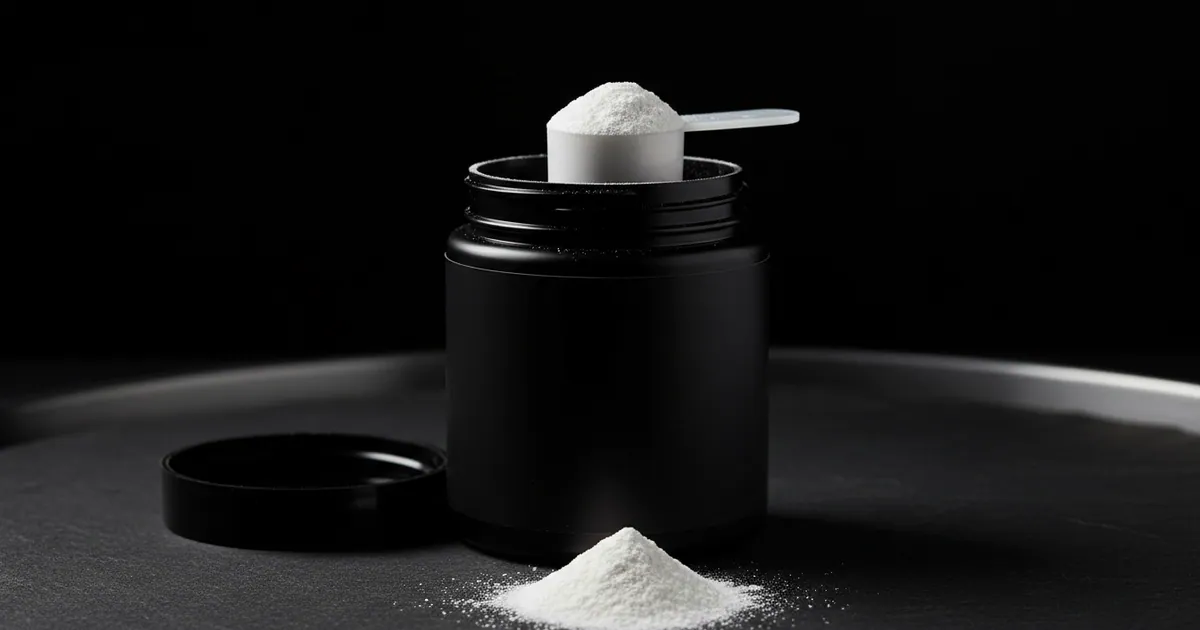
Supplement Guides
Creatine During a Cut: Should You Keep Taking It?
Creatine is the most researched performance supplement in existence and one of the few that consistently delivers. But when a cut begins, people often stop taking it — worried about water retention masking fat loss on the scales. This is almost always the wrong call.
What Creatine Actually Does
Creatine is stored in your muscles as phosphocreatine and acts as a rapid energy reserve for short, intense efforts — sprints, heavy lifts, explosive movements. Supplementing with creatine increases these phosphocreatine stores, which translates to:
- More reps at a given weight
- Better performance on subsequent sets
- Faster recovery between high-intensity efforts
- A small but real increase in strength over time
None of this stops being useful during a cut. If anything, it's more useful — because you need every bit of help you can get to maintain training intensity on reduced calories.
The Water Retention Issue
This is the main reason people stop taking creatine on a cut. Creatine supplementation draws water into muscle cells (intracellular water retention), which typically adds 1–2kg to scale weight when you first start or restart supplementation.
Here's the thing: this isn't fat. It's water inside your muscle cells. It makes muscles look fuller, not fatter. And it's actually part of the mechanism by which creatine supports muscle protein synthesis.
If you're tracking your cut using scale weight only, yes — creatine complicates the picture during the loading phase. But once you're already supplementing and that initial water weight is stable, continuing creatine has no meaningful effect on scale fluctuations.
Pro Tip
If water retention on the scales bothers you, don't cycle on or off creatine during your cut. Just keep taking it consistently at 3–5g per day and track body composition with progress photos and measurements alongside scale weight.
Does Creatine Help Preserve Muscle on a Cut?
Multiple studies have examined creatine supplementation during calorie restriction and found it helps preserve lean mass compared to placebo. The mechanism is indirect — by helping you maintain training performance (higher loads, more reps), you're giving your body a stronger signal to retain muscle tissue.
A 2003 study in the Journal of Strength and Conditioning Research found that creatine supplementation during an 8-week calorie-restricted period helped trainees maintain both strength and lean mass significantly better than placebo. This effect is well-supported by subsequent research.
Should You Load?
Loading (taking 20g/day for 5–7 days) saturates your stores faster but increases initial water retention. During a cut, there's no advantage to loading. A maintenance dose of 3–5g per day reaches full saturation within 3–4 weeks and avoids the sharp initial water weight spike.
If you've been taking creatine before your cut, just continue your maintenance dose. No need to adjust.
Timing: Does It Matter?
The research on creatine timing is mixed. Some studies suggest post-workout is marginally better; others find no difference. The practical answer: take it when you'll remember to. A consistent 3–5g daily — any time of day — is all you need.
Many people take it with their post-workout protein shake for convenience. This is fine.
Warning
Creatine increases the need for adequate hydration. Aim for at least 2–2.5 litres of water daily. If you're training hard and sweating, more is better. Dehydration on creatine can worsen muscle cramps.
Which Type of Creatine?
Creatine monohydrate. Full stop. Every other form — creatine HCl, buffered creatine, creatine ethyl ester — is more expensive and not more effective. Monohydrate is what virtually all the positive research uses. Buy the cheapest pure monohydrate you can find.

Affiliate partner
Creatine + recovery stack — APMZEE
Premium UK supplements — 4 pillars: Action, Performance, Movement, Sleep
Myprotein Impact Whey
The UK's best-selling protein powder. 21g protein per scoop, under 50p per serving on sale.
Affiliate link. See our disclosure.
Key Takeaways
- Keep taking creatine on your cut — it helps maintain training performance and preserves lean mass
- Initial water retention (1–2kg) is intracellular and not fat; it stabilises quickly
- 3–5g per day is sufficient; no loading needed during a cut
- Creatine monohydrate is the only form worth buying
- Stay well hydrated when supplementing creatine
Newsletter
Cut smarter, every Sunday
One deep-dive guide, one recipe, one tip. No spam. No bro-science. Unsubscribe anytime.
More like this
Related guides
Supplement Guides
Electrolytes During a Cut: Do You Need to Supplement?
5 min read
Supplement Guides
BCAAs: Are They a Waste of Money?
5 min read
Supplement Guides
Protein Powder Buyer's Guide UK: What to Buy and What to Avoid
7 min read
Supplement Guides
Best Supplements for Cutting: Ranked and Reviewed
8 min read