Beginner
Meal Timing for Beginners: Does When You Eat Actually Matter?
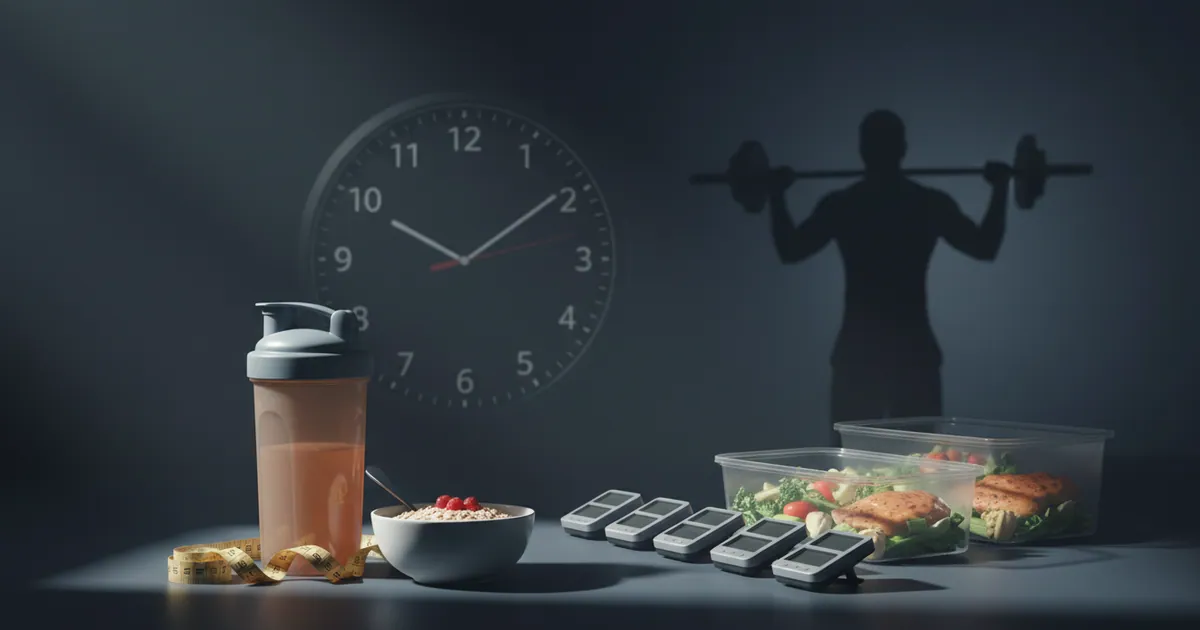
Meal timing is one of the most obsessed-over topics in fitness. "Eat 6 small meals a day to stoke your metabolism." "Fast for 16 hours to burn more fat." "Eat carbs only before training." The reality is considerably more nuanced — and more reassuring — than most of this advice suggests.
The anchor paper is Aragon and Schoenfeld's 2013 narrative review Nutrient timing revisited: is there a post-exercise anabolic window of opportunity? in the Journal of the International Society of Sports Nutrition — still the most comprehensive rebuttal of the "30-minute window" myth. The short version: for most trainees, meal timing is a small edge on top of total calorie and protein targets, not a separate lever.
The Most Important Thing First
Total daily calories and macros matter far more than when you eat them. If you hit your calorie deficit and protein targets, meal timing produces only marginal differences in fat loss and muscle retention.
Aragon & Schoenfeld (2013) reviewed the evidence for nutrient timing around training and concluded that the acute post-workout period is not the decisive variable most people assume it is. Total daily protein and energy intake dominate. Schoenfeld, Aragon and Krieger's follow-up 2013 meta-analysis in the same journal quantified this: across 23 studies, protein timing around workouts produced no significant effect on strength or hypertrophy once total daily protein intake was matched.
That said, "minimal" isn't zero. There are some timing considerations worth knowing.
Protein Distribution
The one meal timing factor with meaningful research support: spreading protein intake across multiple meals produces better muscle protein synthesis (MPS) than eating the same total protein in fewer, larger servings.
Schoenfeld and Aragon (2018), reviewing the per-meal protein utilisation literature in the Journal of the International Society of Sports Nutrition, concluded that roughly 0.4 g/kg bodyweight per meal across four meals is the most defensible practical recommendation for maximising muscle protein synthesis over a 24-hour period. For an 80kg lifter, that's about 32g protein × 4 meals = ~128g daily — below the recommended total for lean mass accrual, which is why most people should treat 0.4 g/kg as a floor per meal rather than a cap.
Practical application: Eat 3–4 meals that each hit roughly 30–40g of protein. Don't skip meals or eat all your protein in one sitting if you can help it.
Pro Tip
You don't need 6 meals a day. Three solid protein-containing meals plus one or two snacks if needed covers the protein distribution requirement without requiring constant food preparation.
Pre and Post-Workout Nutrition
Post-workout
The "anabolic window" — the idea that you must eat protein immediately after training or gains disappear — has been significantly overblown. Schoenfeld, Aragon and Krieger (2013), in their meta-analysis of protein timing in resistance training, found no significant effect of consuming protein within ≤1 hour versus >1 hour post-workout on strength or hypertrophy once total daily protein was matched. Aragon & Schoenfeld's 2013 review had already argued the window is closer to several hours — not 30 minutes — and the meta-analysis confirmed it.
That said, eating protein within 1–2 hours after training is still sensible practice, particularly if you trained in a fasted state or haven't eaten for several hours — it fits protein distribution guidance (Schoenfeld & Aragon 2018) rather than magical-window logic.
Pre-workout
Training with food in your system generally supports better performance than training fully fasted. If you can eat 1–2 hours before training, a balanced meal with carbohydrates and protein supports energy and performance.
Some people train well in a fasted state (typically with caffeine). If this works for you without significant performance loss, it's fine. The fat-burning benefit of fasted training is minimal compared to overall calorie balance.
Intermittent Fasting
Intermittent fasting (IF) protocols — typically 16:8 or similar — are popular cutting tools. Research suggests IF produces similar fat loss outcomes to standard dieting when calories are matched (Gu et al. 2022 meta-analysis of 43 RCTs in Frontiers in Nutrition). The mechanism is simply that restricting the eating window tends to reduce overall calorie intake.
IF can be useful if:
- It suits your schedule and hunger patterns
- You find it easier to skip breakfast than to eat a restricted breakfast
- It helps you avoid mindless eating in the evening
IF is less suitable if:
- It causes extreme hunger that leads to overeating
- It impairs morning training performance
- It makes hitting protein targets more difficult (fitting 160g protein into an 8-hour window requires planning)
Does Eating Late Cause Fat Gain?
The short answer: no, not directly. A calorie eaten at 10pm is the same as a calorie eaten at 10am in terms of energy balance. The "don't eat after 8pm" rule has no solid basis in physiology.
The practical concern is that eating late can interfere with sleep quality (large meals close to bedtime) and that evening eating is often habitual snacking rather than planned, nutritious eating.
Warning
Be careful with the "I'll make up my calories at night" approach. Research shows evening hunger tends to drive higher-calorie, more palatable food choices and makes portion control harder. Front-loading calories slightly earlier in the day often supports better adherence.
Pre-Workout Powder
Caffeine + citrulline + beta-alanine. Makes a noticeable difference on low-energy days.
Affiliate link. See our disclosure.
Key Takeaways
- Total calories and macros matter far more than meal timing — Aragon & Schoenfeld (2013) established this as the dominant finding of the nutrient-timing literature
- Spreading protein across 3–4 meals at ~0.4 g/kg per meal is the best-supported distribution pattern (Schoenfeld & Aragon 2018)
- Post-workout protein within 1–2 hours is sensible but the "30-minute window" is a myth — Schoenfeld, Aragon & Krieger (2013) meta-analysis found no timing effect at matched daily protein
- Intermittent fasting works for some people, doesn't for others — it's a preference tool, not a superior diet approach (Gu 2022 meta-analysis)
- Eating late doesn't directly cause fat gain; the issue is usually what and how much is eaten late at night
Sources
- Aragon AA, Schoenfeld BJ (2013). Nutrient timing revisited: is there a post-exercise anabolic window of opportunity? Journal of the International Society of Sports Nutrition. PMC free full text
- Schoenfeld BJ, Aragon AA, Krieger JW (2013). The effect of protein timing on muscle strength and hypertrophy: a meta-analysis. Journal of the International Society of Sports Nutrition. PMC free full text
- Schoenfeld BJ, Aragon AA (2018). How much protein can the body use in a single meal for muscle-building? Implications for daily protein distribution. Journal of the International Society of Sports Nutrition. PMC free full text
- Gu L et al. (2022). Effects of Intermittent Fasting in Human Compared to a Non-intervention Diet and Caloric Restriction: A Meta-Analysis of Randomized Controlled Trials. Frontiers in Nutrition. PMC free full text
Newsletter
Cut smarter, every Sunday
One deep-dive guide, one recipe, one tip. No spam. No bro-science. Unsubscribe anytime.
More like this