Cutting Fundamentals
How to Cut Without Losing Muscle
The biggest fear when starting a cut is watching hard-earned muscle disappear along with the fat. It's a legitimate concern — your body doesn't distinguish perfectly between fat and muscle when it's short on energy. But with the right approach, you can shift that balance heavily in your favour.
The single most useful paper for framing this is Helms, Aragon and Fitschen (2014), Evidence-based recommendations for natural bodybuilding contest preparation: nutrition and supplementation (Journal of the International Society of Sports Nutrition). Its practical recommendations — 0.5–1% bodyweight loss per week, 2.3–3.1 g/kg FFM protein, resistance training preserved — are what most evidence-based coaches still work from. Ruiz-Castellano et al. (2021) updated the framework specifically for resistance-trained athletes in Nutrients and reached the same conclusions.
Why Muscle Loss Happens During a Cut
When you're in a calorie deficit, your body needs to find energy from somewhere. Fat stores are the ideal source, but muscle tissue is also fair game — especially if your deficit is aggressive, your protein is low, or you stop giving your muscles a reason to stick around.
The body doesn't hold muscle out of sentiment — it holds it because something is demanding it. Remove the demand (stop lifting), reduce the raw material (cut protein), or overwhelm the system (huge deficit) and you start losing lean mass. Helms 2014 identifies those three as the primary modifiable variables for muscle retention.
Eat Enough Protein
Protein is the primary lever for muscle preservation. During a cut, your requirements actually increase — your body cannibalises muscle for fuel more readily when protein is scarce.
Murphy, Hector and Phillips (2015), in their Applied Physiology, Nutrition, and Metabolism review Considerations for protein intake in managing weight loss in athletes, concluded that protein requirements for resistance-trained athletes in a deficit are significantly higher than the general RDA, with recommendations of around 1.6–2.4 g/kg bodyweight per day, favouring the upper end when the deficit is more aggressive or the athlete is leaner. Helms et al. (2014) recommended 2.3–3.1 g/kg of fat-free mass for natural bodybuilders specifically in contest prep, which maps to similar totals once you account for body composition.
For an 80 kg trainee, that's 144–192g of protein daily. This might feel like a lot, but it pays off in retained lean mass and better satiety.
Pro Tip
Spread protein across at least 3–4 meals. Schoenfeld and Aragon (2018) concluded the most defensible per-meal target is ~0.4 g/kg bodyweight — roughly 30–40g per meal for most adults — maximising the muscle protein synthesis response across the day rather than front- or back-loading it.
Keep Lifting, Keep It Heavy
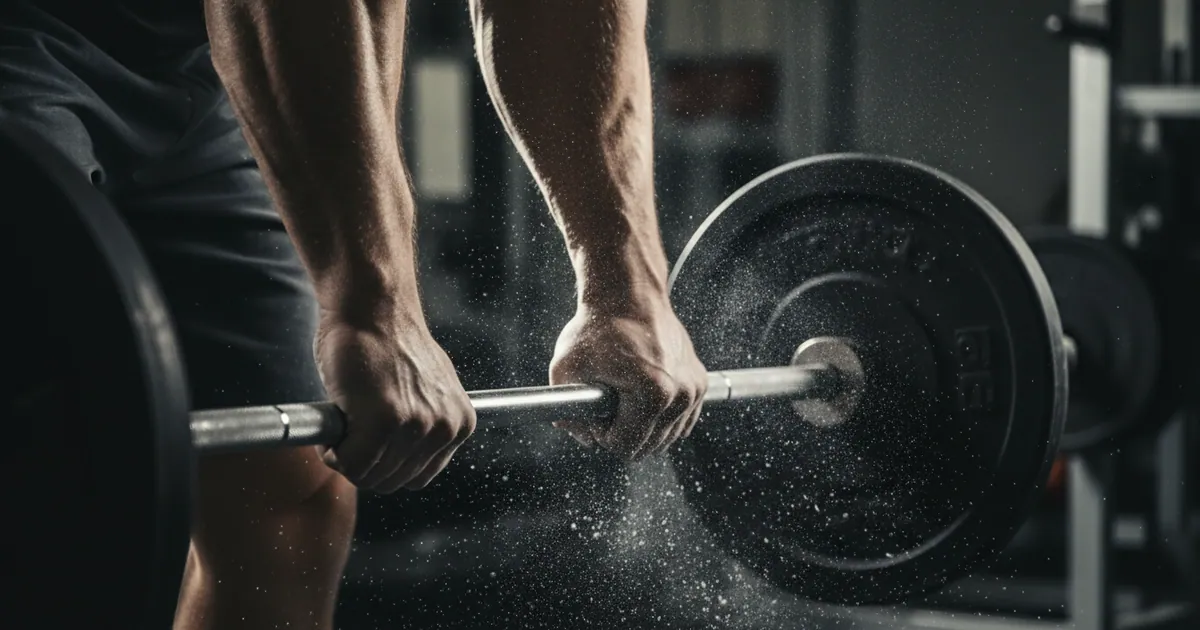
Reducing calories doesn't mean reducing intensity. The biggest mistake people make during a cut is switching entirely to light, high-rep work thinking it "tones" better. It doesn't — that's a myth.
Keep your compound lifts — squats, deadlifts, rows, bench, overhead press — in your programme. You may need to reduce total volume slightly (fewer sets per session) to manage fatigue, but keep the weights close to your working loads. This is the stimulus that tells your body to hold onto muscle. Roth et al. (2022), in their Sports Medicine review of training during energy restriction, confirmed that intensity (load) matters more for lean-mass preservation than volume in deficit — reducing sets by 20–30% while keeping loads heavy is the standard recommendation.
Control Your Deficit
An aggressive deficit accelerates fat loss but also accelerates muscle loss. Helms et al. (2014) explicitly recommend 0.5–1% of bodyweight per week as the rate of loss that preserves lean mass for natural bodybuilders — slower for lean lifters, faster for heavier starting points. That corresponds in calorie terms to roughly 300–500 kcal/day deficit for a slow cut, up to 750 kcal/day for people with more fat to lose.
Going beyond 1,000 kcal/day significantly increases muscle loss risk for most people. Ruiz-Castellano 2021 came to the same conclusion: the evidence does not support aggressive deficits for resistance-trained athletes whose goal is physique preservation.
Warning
Crash diets (very low calorie diets under 800 kcal/day) can cause significant muscle loss within days, not weeks. The combination of inadequate protein and insufficient training fuel is the worst-case scenario for lean mass. Helms 2014 explicitly cautions against aggressive deficits in already-lean lifters.
Sleep and Recovery
Sleep is where muscle repair happens. Nedeltcheva et al. (2010), in Annals of Internal Medicine, ran a classic crossover study in which calorie-restricted subjects lost 60% more fat-free mass (muscle) when sleeping 5.5 hours versus 8.5 hours on the same diet. That's not a nuance — that's a tripling of muscle loss caused by one lever: sleep.
Aim for 7–9 hours. If you're cutting calories and sleeping poorly, you're fighting yourself.
Consider Creatine
Creatine monohydrate is one of the most well-researched supplements available. During a cut, it helps maintain strength and power output, which in turn supports the training stimulus needed to preserve muscle. Kreider et al. (2017), in the ISSN position stand on creatine, classify it as safe and effective for strength and lean-mass support — and specifically note that creatine does not interfere with fat loss when total calorie intake is controlled. It's cheap, safe, and effective. 3–5g daily is the standard dose — no loading phase required.
Creatine Monohydrate
The most researched supplement in existence. 5g daily, unflavoured, mixes into anything.
Affiliate link. See our disclosure.
Key Takeaways
- Protein at 1.6–2.4 g/kg bodyweight is essential for muscle retention in a deficit — Murphy 2015 and Helms 2014 agree on the upper range
- Keep resistance training in your programme — lift heavy, reduce volume if needed (Roth et al. 2022 on intensity > volume for lean-mass preservation in deficit)
- A moderate deficit (300–750 kcal/day) targeting 0.5–1% bodyweight loss per week limits muscle loss (Helms 2014)
- Prioritise sleep — Nedeltcheva 2010 found 5.5h vs 8.5h tripled muscle loss on the same deficit
- Creatine monohydrate supports training performance during a cut (Kreider et al. 2017 ISSN stand)
Sources
- Helms ER, Aragon AA, Fitschen PJ (2014). Evidence-based recommendations for natural bodybuilding contest preparation: nutrition and supplementation. Journal of the International Society of Sports Nutrition. PMC free full text
- Murphy CH, Hector AJ, Phillips SM (2015). Considerations for protein intake in managing weight loss in athletes. European Journal of Sport Science. PubMed
- Ruiz-Castellano C et al. (2021). Achieving an Optimal Fat Loss Phase in Resistance-Trained Athletes: A Narrative Review. Nutrients. PMC free full text
- Roth C et al. (2022). Training Volume and Intensity during Energy Restriction: A Narrative Review for Resistance-Trained Athletes. Sports Medicine — Open. PMC free full text
- Schoenfeld BJ, Aragon AA (2018). How much protein can the body use in a single meal for muscle-building? Implications for daily protein distribution. Journal of the International Society of Sports Nutrition. PMC free full text
- Nedeltcheva AV et al. (2010). Insufficient sleep undermines dietary efforts to reduce adiposity. Annals of Internal Medicine. PMC free full text
- Kreider RB et al. (2017). International Society of Sports Nutrition position stand: safety and efficacy of creatine supplementation in exercise, sport, and medicine. Journal of the International Society of Sports Nutrition. PMC free full text
Newsletter
Cut smarter, every Sunday
One deep-dive guide, one recipe, one tip. No spam. No bro-science. Unsubscribe anytime.
More like this