Beginner
How to Calculate Your Macros for a Cut
"Counting macros" gets thrown around constantly in fitness content, but many people are fuzzy on what it actually means and how to set their targets. This guide walks you through the process step by step.
What Are Macros?
Macronutrients — macros — are the three main categories of nutrients that provide calories:
- Protein: 4 calories per gram
- Carbohydrates: 4 calories per gram
- Fat: 9 calories per gram
(Alcohol also provides calories — 7 per gram — but isn't a macronutrient in the traditional sense.)
Tracking macros means tracking how many grams of each you eat, not just total calories. This is useful because each macro has different effects on body composition, satiety, and performance.
Step 1: Calculate Your TDEE
TDEE (Total Daily Energy Expenditure) is how many calories you burn in a day at your current activity level. Use the Katabolic TDEE calculator to get your number, or use this as a rough guide:
Harris-Benedict formula (simplified):
- Men: 10 × weight (kg) + 6.25 × height (cm) − 5 × age + 5 = BMR
- Women: 10 × weight (kg) + 6.25 × height (cm) − 5 × age − 161 = BMR
Multiply your BMR by an activity factor:
- Sedentary (desk job, no exercise): × 1.2
- Lightly active (1–2 workouts/week): × 1.375
- Moderately active (3–5 workouts/week): × 1.55
- Very active (6–7 workouts/week): × 1.725
The result is your approximate TDEE.
Step 2: Set Your Calorie Target
Subtract 300–500 calories from your TDEE for a moderate cutting deficit.
Example: TDEE of 2,600kcal → target of 2,100–2,300kcal for a cut.
Don't go below 1,400–1,500kcal for women or 1,600–1,800kcal for men without medical supervision, regardless of what the formula says. Very low calorie diets significantly increase muscle loss risk.
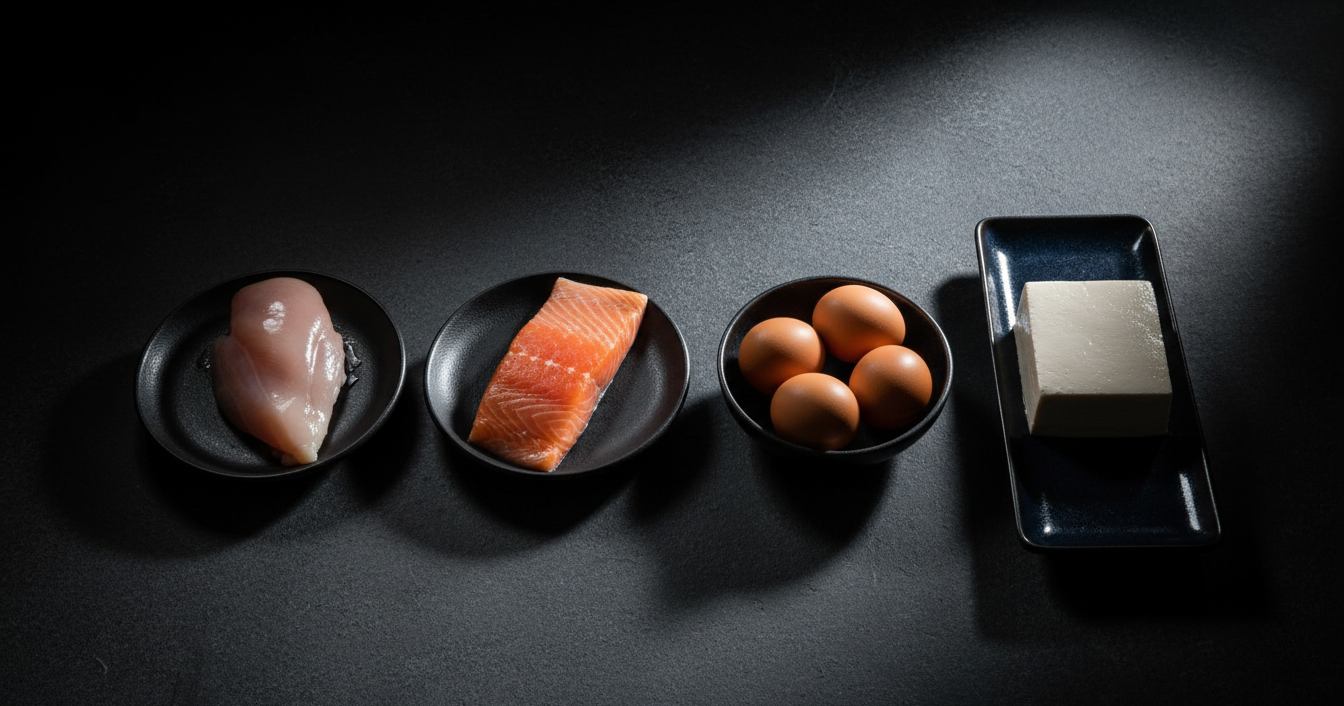
Step 3: Set Your Protein Target
Protein comes first. During a cut, aim for 2.0–2.4g per kg of bodyweight (lean mass if you know your body fat percentage; total bodyweight if you don't). The 1.6 g/kg figure commonly cited in general muscle-building guidance is the lower bound — in a caloric deficit, pushing toward the upper end of the range is what preserves lean mass. Trexler and colleagues' 2014 JISSN review on metabolic adaptation for athletes recommends at least 2.0 g/kg lean body mass during restriction; Helms et al. (2014) put natural bodybuilders at 2.3–3.1 g/kg during contest prep.
Pro Tip
Evolving evidence on the protein ceiling. The widely-quoted 1.6 g/kg ceiling traces to the Morton et al. 2018 British Journal of Sports Medicine meta-analysis. A 2024 re-analysis by Greg Nuckols (Stronger By Science) showed the ceiling in that meta-analysis was poorly identified — the confidence interval extends well past 2.2 g/kg, with point estimates suggesting additional hypertrophy at higher intakes. For cutting specifically, the honest range is 1.6–2.6 g/kg, and 2.0–2.4 g/kg sits comfortably inside the defensible upper bound. Tagawa et al. 2020 in Nutrition Reviews reached the same dose-response conclusion independently.
Example: 80kg person → 160–192g protein per day. Use 180g as your target.
Calories from protein: 180g × 4 = 720 calories.
Step 4: Set Your Fat Target
Fat is essential for hormones, cell function, and vitamin absorption. Don't go too low. A reasonable minimum is 0.8–1g per kg of bodyweight, or 20–30% of total calories.
Example: 80kg person → 64–80g fat minimum. Use 70g.
Calories from fat: 70g × 9 = 630 calories.
Step 5: Fill Remaining Calories with Carbohydrates
Subtract protein and fat calories from total calorie target. The remainder goes to carbohydrates.
Example:
- Total calories: 2,100
- Protein calories: 720
- Fat calories: 630
- Remaining for carbs: 2,100 − 720 − 630 = 750 calories
- Carbs in grams: 750 ÷ 4 = 188g carbohydrate
Final example macro targets:
- Protein: 180g
- Fat: 70g
- Carbs: 188g
- Total: ~2,100kcal
Pro Tip
These numbers are a starting point, not a prescription. After 3–4 weeks, assess progress. If you're losing weight too fast (more than 1kg/week consistently), eat slightly more. Too slow (nothing after 3 weeks), reduce by 100–200kcal.
Adjusting Macros Over Time
As you lose weight, your TDEE decreases. Recalculate every 4–6 weeks using your new bodyweight, or when progress stalls for more than 2–3 weeks.
You may also want to adjust the carb/fat ratio:
- More carbs, less fat on training days: Carbs fuel performance better
- More fat, fewer carbs on rest days: Fat provides sustained energy; less glycogen needed
This approach is called carb cycling, which some people find improves both energy and adherence.
What If You Don't Want to Count Macros?
Full macro tracking (weighing and logging everything) is the most accurate approach. But it's not the only way. Simpler alternatives:
- Protein only tracking: Hit your protein target; eat other foods to appetite from a list of approved options
- Plate method: Half plate vegetables, quarter protein, quarter starchy carbs
- Calorie-only tracking: Don't break down macros; just stay under your calorie target
Any of these can work. Full macro tracking is the most reliable for body composition goals.
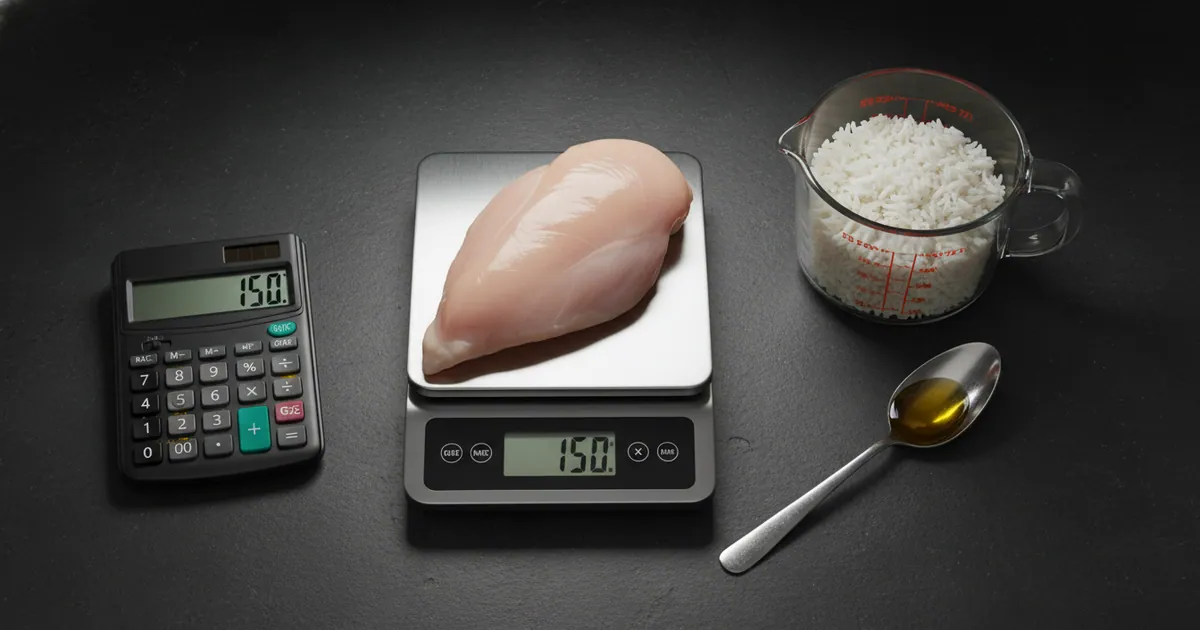
Digital Kitchen Scale
Accurate to 1g. The single most useful tool for hitting macros consistently.
Affiliate link. See our disclosure.
Key Takeaways
- Macros are protein (4kcal/g), carbohydrates (4kcal/g), and fat (9kcal/g)
- Set calories first (TDEE minus 300–500), then protein (2.0–2.4g/kg for cutting), then fat (0.8–1g/kg), then carbs fill the rest
- For an 80kg person cutting on 2,100kcal: roughly 180g protein, 70g fat, 188g carbs
- Recalculate every 4–6 weeks as bodyweight changes
- These are starting points — adjust based on actual progress over 3–4 weeks
Newsletter
Cut smarter, every Sunday
One deep-dive guide, one recipe, one tip. No spam. No bro-science. Unsubscribe anytime.
More like this